The DAF Playbook for Nonprofits: How to Access $326B in Donor-Advised Funds
Jacob Schoenberg
7 min
You're Sitting on a Funding Source That Doesn't Require a Grant Proposal
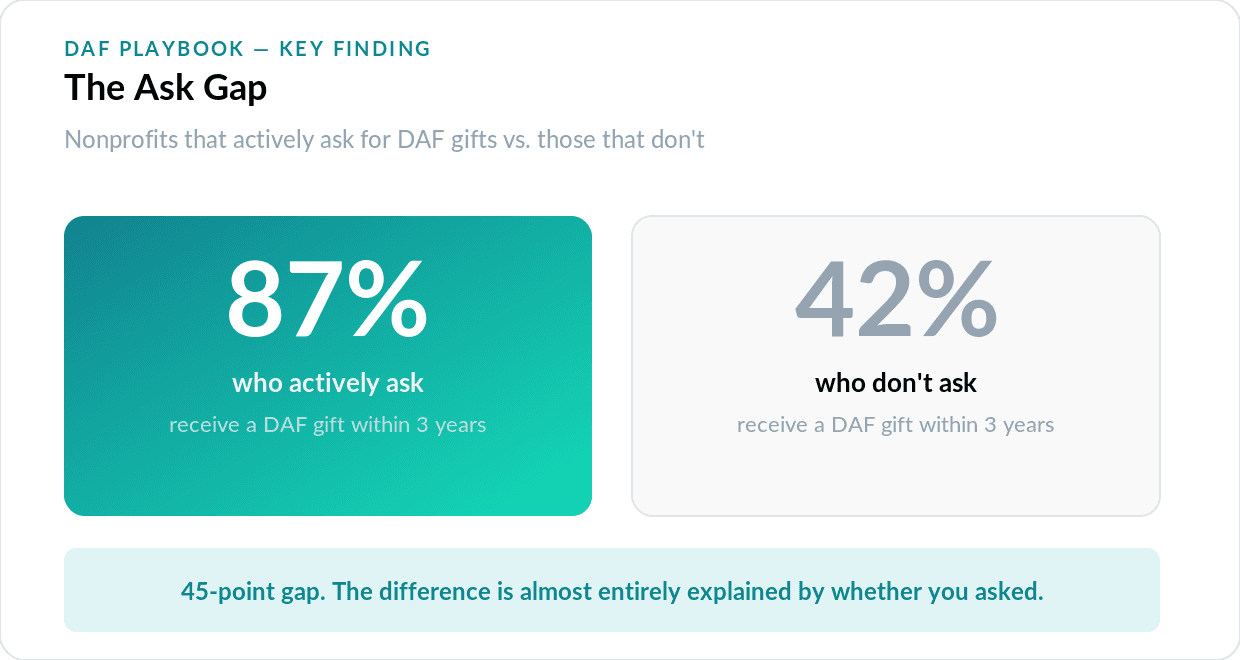
87% of nonprofits that actively ask for donor-advised fund gifts receive one within three years. Only 42% of nonprofits that don't ask receive them.
That gap between asking and not asking is the entire DAF opportunity in one stat.
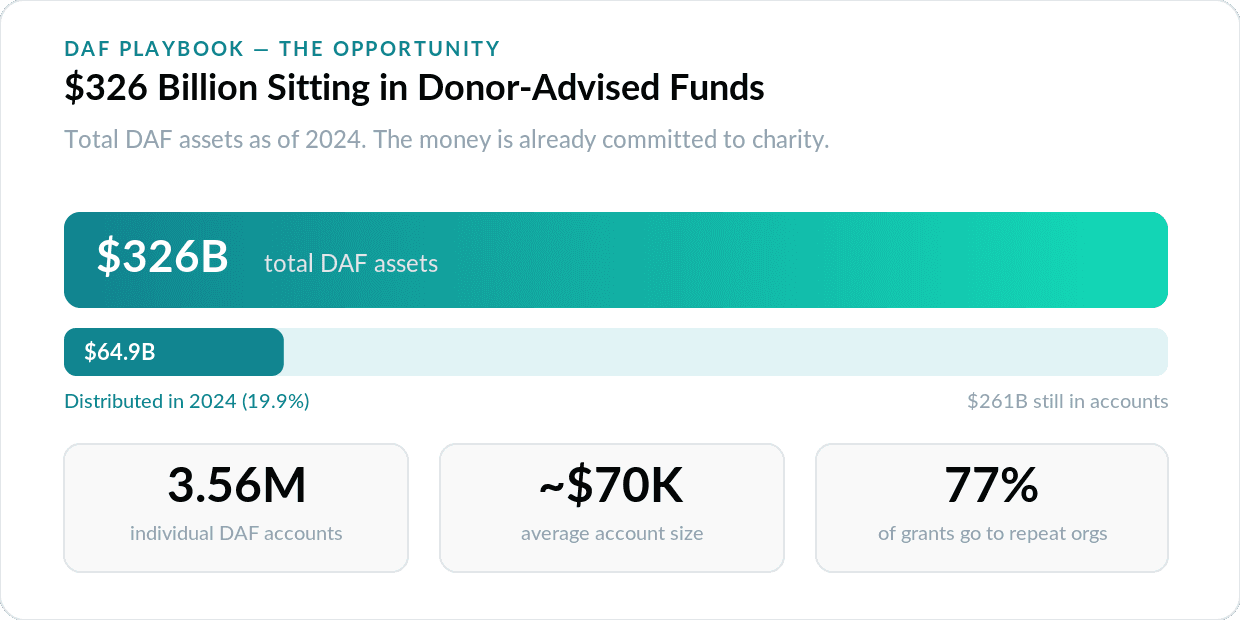
There are $326 billion sitting in donor-advised funds right now. That money is already committed to charity. It's not waiting on a congressional vote or a foundation board meeting. A DAF holder can direct a grant to your organization in days. No application, no review cycle, no 6-month wait.
And most nonprofits aren't pursuing it at all.
Why DAFs Are Different From Everything Else in Your Pipeline
Most development teams treat DAFs like individual donations. Passively. The assumption is that if a donor has a DAF, they'll direct money your way when they're ready.
That's how you miss the opportunity. Because DAFs are structurally different from every other funding channel you're working:
Speed. A DAF donor can direct a grant in days. The money is already in a charitable account. The only question is where it goes.
Flexibility. DAF distributions typically come with fewer restrictions than foundation or government grants. Many are unrestricted. For organizations drowning in compliance requirements, this is oxygen.
Scale. The average DAF account holds ~$70,000. High-net-worth accounts hold significantly more. A single DAF relationship can replace months of small-dollar fundraising.
Recurring potential. 77% of DAF grants go to organizations donors have previously supported. Nearly 40% of all distributions are now recurring or scheduled. Once you're in, you tend to stay in.
Why Most Nonprofits Fail at DAF Fundraising
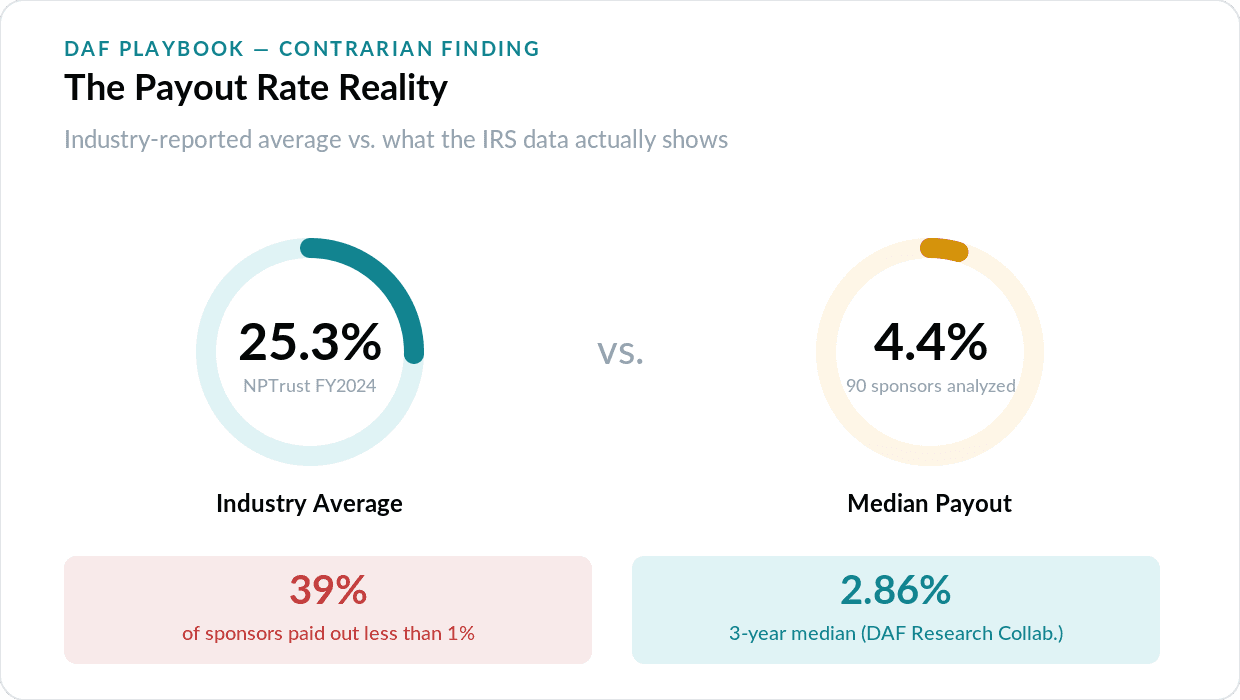
The DAF industry reports a 25.3% average payout rate (NPTrust, FY 2024). That sounds healthy. It isn't.
When we analyzed 90 DAF sponsors using complete 2023 IRS financial data, the median payout rate was 4.4%. 39% of those sponsors paid out less than 1% of their assets. Independent researchers have found similar patterns: a three-year median as low as 2.86% (DAF Research Collaborative). One study found 35% of DAFs distributed nothing at all.
The headline number is real. It's just concentrated. Fidelity Charitable alone distributed $14.9 billion in 2024 and $18.3 billion in 2025, a record year. A handful of major sponsors are moving enormous amounts of money while the long tail sits on theirs.
This is why a passive approach doesn't work. If you're not visible to the donors at the sponsors that actually distribute, you're competing for scraps from the ones that don't.
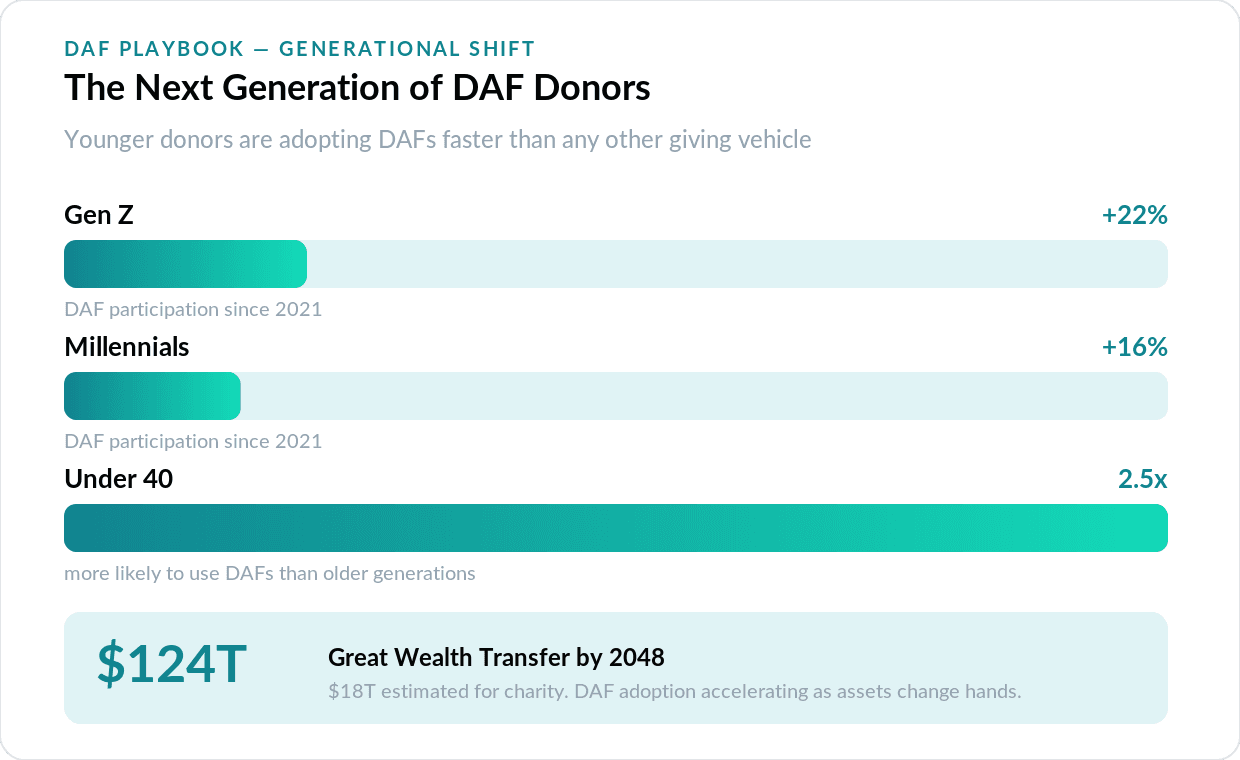
The generational shift makes this more urgent, not less. Donors under 40 are 2.5x more likely to use DAFs than older generations. Millennial DAF participation is up 16% since 2021. Gen Z is up 22%. The Great Wealth Transfer ($124 trillion flowing between generations by 2048, with $18 trillion estimated for charity) is accelerating DAF adoption. The donor base is growing younger, more digitally engaged, and more inclined to give through DAFs than any other vehicle.
And there's a regulatory tailwind: the One Big Beautiful Bill Act's 2026 tax changes (0.5% AGI floor on charitable deductions, 35% cap for top-bracket donors) mean 2025 was the optimal year to fund DAFs. The money is already in accounts. Without mandatory payout requirements (which Congress did not impose), it stays parked unless donors are actively engaged.
That's your opening.
Your DAF Playbook: 5 Steps to Start Accessing This Funding
Step 1: Identify the Right DAF Sponsors to Target
Not every DAF sponsor is relevant to your organization. And as the payout data shows, not every sponsor actually moves money. Start by mapping the active sponsors to your cause area and geography.
National sponsors (Fidelity, Schwab, Vanguard) are volume plays. Millions of accounts, broad cause distribution. Your organization shows up in their donor-facing search tools if your profile is optimized (Step 2).
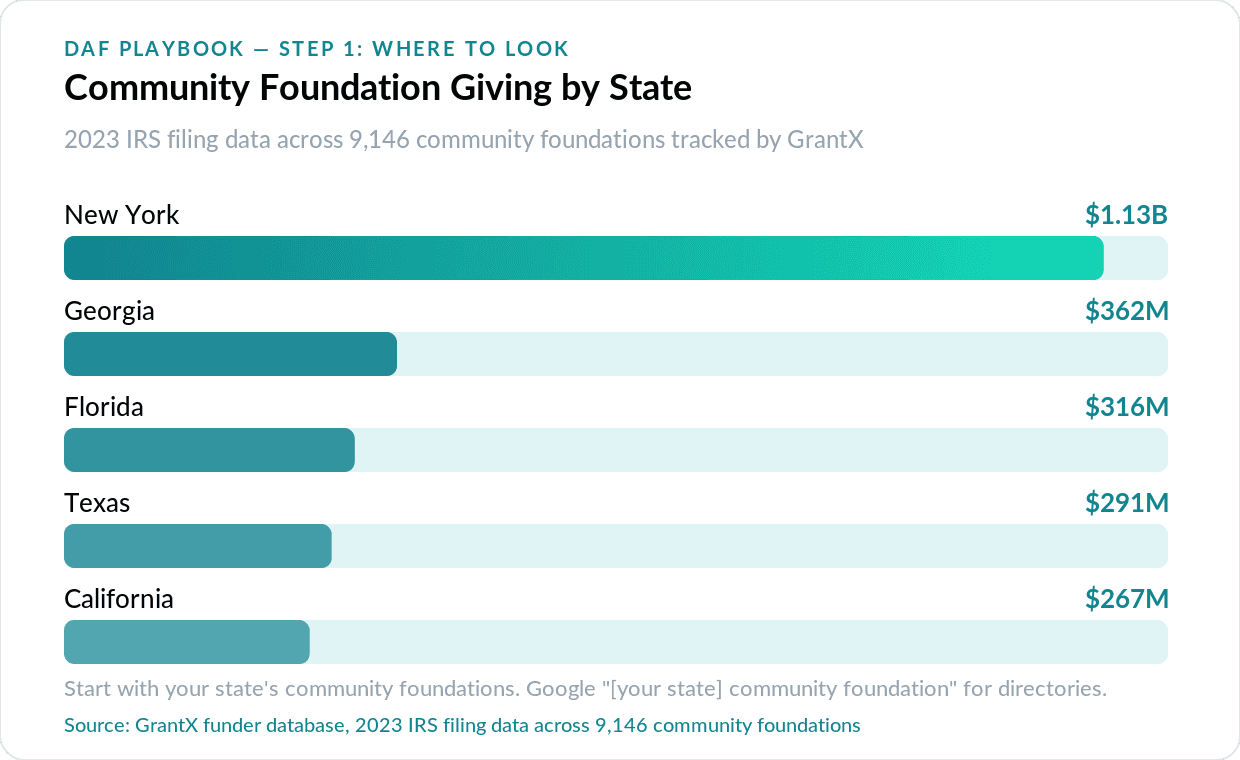
Community foundation DAFs are relationship plays. These are local. The program officers know your region. If you have existing relationships with community foundations, ask specifically about their DAF holders. Many actively recommend local nonprofits to their DAF donors. Community foundation giving is geographically concentrated. In an analysis of 9,146 community foundations, New York alone accounted for $1.13 billion in 2023 giving, with Georgia, Florida, and Texas each clearing $250 million+.
Single-issue charity DAFs are precision plays. If your mission aligns tightly with a cause-specific fund (environmental, faith-based, education, health), these sponsors have the highest payout rates in the industry and the most aligned donors.
Action: Build a list of 10-15 DAF sponsors. Start with your 3 closest community foundations (Google "[your state] community foundation"; most have directories), the 3 national sponsors, and any single-issue funds that align with your mission. This is your prospect list.
Step 2: Optimize Your Visibility to DAF Donors
Here's the thing nobody tells you: your organization is probably already registered on Fidelity Charitable's platform. But your profile likely says "general charitable purposes" and has no contact information. That's why DAF donors scroll past you.
DAF donors use their sponsor's platform to search for and direct grants to nonprofits. If your profile is blank or outdated, you don't exist to them.
Check your profiles on:
Fidelity Charitable's Giving Account search
Schwab Charitable's charity search
Vanguard Charitable's nonprofit directory
National Philanthropic Trust's grant recommendation tools
Every community foundation you identified in Step 1
What to fix:
Your EIN is registered and your organization name matches your legal name exactly
A clear, compelling mission description (2-3 sentences max; DAF donors are scanning, not reading grant proposals)
Most recent Form 990 and annual report uploaded
Impact metrics if the platform supports them
A direct contact for institutional gifts (not a generic info@ email)
A DAF donor searching for "food insecurity" in your city will scroll past you if your description says "general charitable purposes." This takes 30 minutes to fix per platform and it compounds forever.