The first quarter of 2026 reshaped federal grant funding in ways that will define the year. If your organization relies on federal dollars — or competes with organizations that do — the landscape looks fundamentally different than it did 90 days ago.
We also know the context you're reading this in. 95% of nonprofit leaders cite burnout as a top concern. Sector turnover is at 19%, compared to 12% in other industries. 60% of leaders say retaining and attracting skilled staff is one of their biggest challenges this year. You're stretched thin, and the funding environment just got harder.
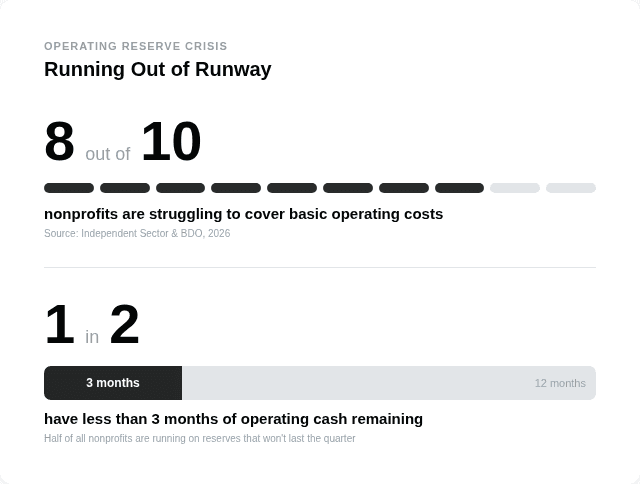
The organizational toll is mounting. Nearly 29,000 nonprofit workers have been laid off since the start of 2025 — a 409% increase over all of 2024. More than half of nonprofits now report three months or less in operating cash. 81% say they're struggling to cover costs.
This report covers what happened to federal funding, where the money is moving, what our own data reveals about the opportunity most organizations are missing, and what to do about it right now.
The Federal Picture
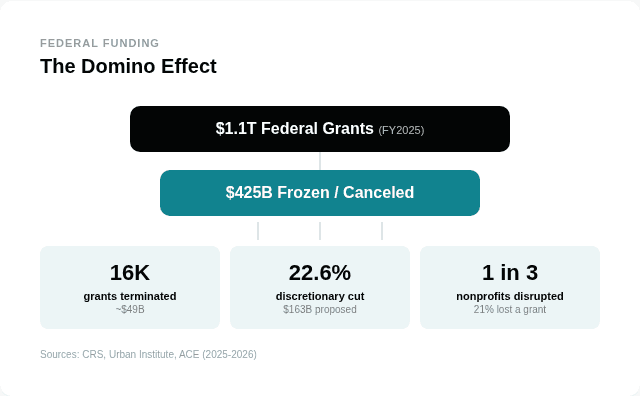
Federal grants to state and local governments totaled $1.1 trillion in FY2025, making the federal government the single largest source of grant funding in the country. That source is now contracting at historic speed.
Since early 2025, the administration has canceled or frozen roughly $425 billion in federal funds across health care, education, arts, and other sectors. The FY2026 budget proposes a 22.6% cut to domestic discretionary spending — a $163 billion reduction. Nearly 16,000 federal grants have been terminated, totaling approximately $49 billion.
Programs hit hardest include:
AmeriCorps — nearly $400 million slashed, 32,000+ positions eliminated
TRIO educational opportunity programs — $660 million withheld
National Endowment for the Humanities — more than $100 million in projected cuts
Justice Department funding — $500 million rescinded
Community Development Block Grant and Community Services Block Grant — proposed for elimination entirely
It's worth noting: these cuts are not all settled. A coalition of 23 state attorneys general has challenged the freeze in court, and federal judges have repeatedly ruled against it — most recently in March 2026, when the U.S. Court of Appeals called the funding suspension "likely improper." But agencies have continued to withhold funds through administrative workarounds despite court orders. For organizations with frozen grants, the legal situation is active, not resolved — and worth monitoring closely.
One in three nonprofits experienced a government funding disruption in 2025. 21% lost a grant outright. The question is no longer whether to adapt, but how fast.
Source: Urban Institute, October 2025
New Rules for Existing Grants
Even grants that survived face new operating constraints. Three changes matter most:
Fund drawdown now requires affirmative agency authorization before each withdrawal, with written documentation for every request.
Indirect cost rates — the Office of Management and Budget is revising guidance to limit them, with agencies prioritizing applicants who propose lower rates.
New termination clauses — new grant terms allow agencies to terminate awards immediately "for convenience" if they determine the award no longer advances agency priorities.
The practical effect: federal grants now carry more administrative burden and more uncertainty. Organizations with heavy federal dependence face real operational risk.
Where the Money Is Moving
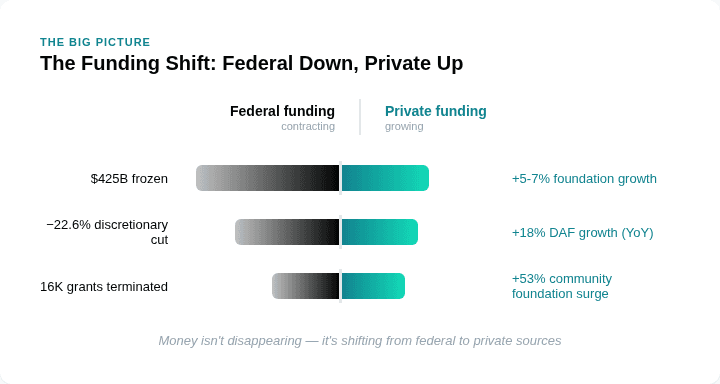
Foundation giving is stepping in — and there’s room for more.
Foundation giving is projected to reach $118–122 billion in 2026, up 5–7% from 2024. Total U.S. charitable giving reached $592.5 billion in 2024 — a 6.3% increase and the first time charitable giving outpaced inflation in three years. 93% of affluent donors plan to maintain or increase their giving this year.
MacKenzie Scott distributed $7.17 billion in 2025 alone — $26.3 billion cumulative since 2019. She's now shifting toward larger, repeat grants to previously funded organizations. That pattern — sustained, growing, independent of federal cycles — is the direction non-federal philanthropy is moving as a whole.
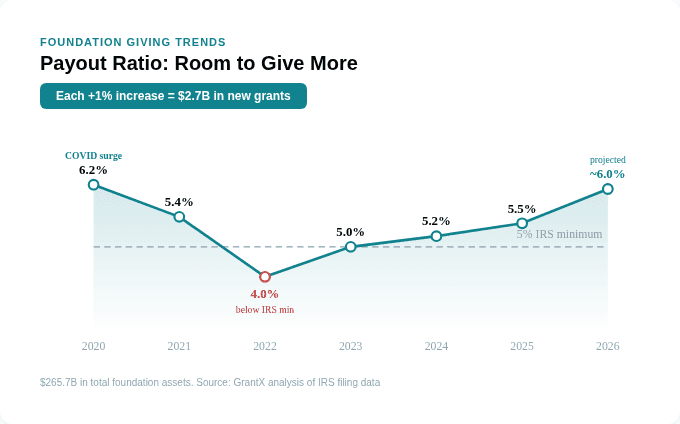
But here's what most organizations don't realize: foundations have significant capacity they haven't deployed yet. Our analysis of IRS filing data across tens of thousands of private and family foundations shows $265.7 billion in total assets. The effective giving-to-assets ratio dropped to 4.0% in 2022 — well below the IRS's 5% minimum distribution threshold — meaning billions in grant capacity went undeployed. It recovered to 5.0% in 2023, and the trajectory heading into 2026 suggests continued recovery. If federal cuts push that ratio up just one percentage point, to 6%, that unlocks an additional $2.7 billion in new grants — without a single new foundation being created.
There's historical precedent for exactly this kind of response. When COVID hit in 2020, average funder giving surged 24% year over year and 30% of foundation leaders increased payouts beyond planned levels. The federal funding crisis of 2025–2026 is a larger shock to the system. If foundations respond the way they did during COVID, organizations positioned to find and apply to those newly available dollars will have a significant advantage this year.
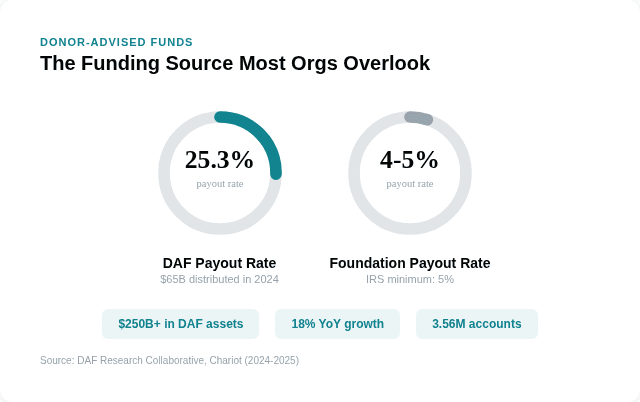
Donor-advised funds are the funding source most organizations overlook.
DAF assets now exceed $250 billion and are growing 18% year over year. In 2024, DAFs distributed $65 billion to nonprofits from 3.56 million accounts — with a 25.3% payout rate, far higher than the 4–5% typical of private foundations. 80% of nonprofits that actively pursued DAF funding saw revenue growth, and half saw increases of 30% or more.
Despite that, most grant-seeking organizations still don't have a DAF strategy. If you're not tracking DAF-affiliated funders alongside traditional foundations, you're missing one of the fastest-growing pools of philanthropic capital in the country.
A new funding category is emerging: AI philanthropy.
Key announcements in 2026:
OpenAI Foundation — $1 billion in grants pledged for 2026, plus a $50 million People-First AI Fund specifically targeting nonprofits
Humanity AI Initiative — $500 million pooled from 10 major foundations including MacArthur, Ford, and Mellon
Gates Foundation — AI for Giving Grand Challenge with grants up to $150,000
KPMG Foundation — $6 million committed for nonprofit AI integration
Some of these programs are aimed at large research institutions — but the People-First AI Fund and the KPMG grants are explicitly designed for community-level nonprofits. Even if your organization doesn't work directly in tech, this signals where major philanthropic dollars are headed. If your work intersects with health, education, workforce development, or any area where technology adoption is relevant, these are funding sources worth tracking.
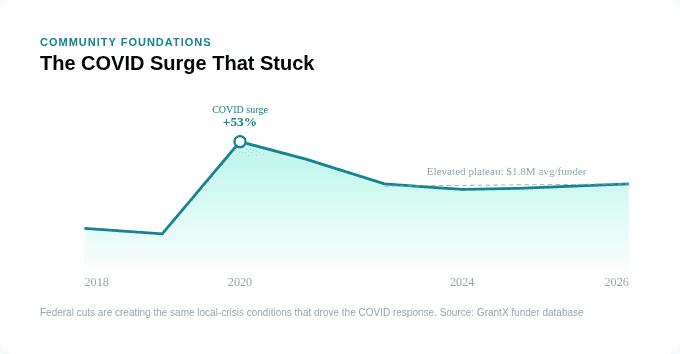
Community foundations are the growth story — and the most likely to respond in 2026.
Our data shows community foundation giving surged 53% during COVID, and even after normalizing it remains elevated at $1.8 million average per funder. These are local organizations that respond to local crises — and federal cuts are creating exactly that kind of crisis at the community level right now.
States are also responding unevenly: some are backfilling federal cuts with new state funding for education, health, and social services, while others are cutting services further. The organizations that build state and community funder relationships now, before the next grant cycles close, will have the advantage heading into Q3.
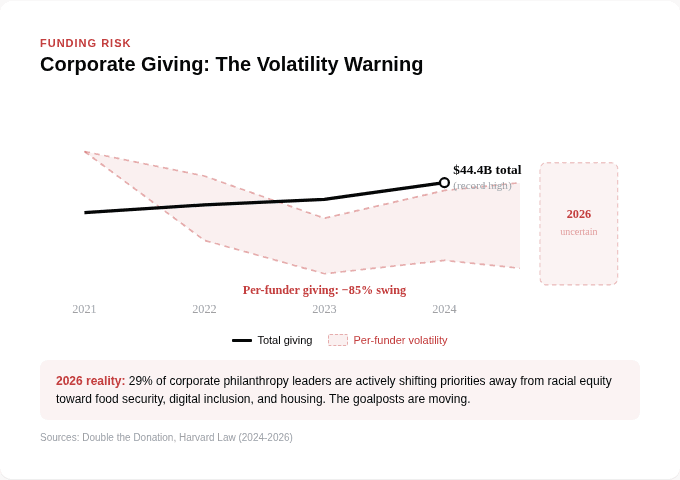
One caution: don’t bank on corporate giving as your federal replacement strategy.
Corporate giving hit a record $44.4 billion in 2024, and 94% of major corporations say they'll maintain or increase giving this year. But our IRS data shows corporate CSR giving per funder collapsed 85% between 2021 and 2023. The dollars are real but volatile — and in 2026, corporate philanthropy leaders are actively shifting priorities: 29% plan to scale back racial equity initiatives in favor of food security, digital inclusion, and housing. For stable, predictable funding in 2026, private foundations and community funders are the more reliable bet.
What Our Data Shows
GrantX tracks 900,000+ active funders across every category — federal, state, private foundation, community foundation, corporate, university, hospital, and more. For funders with financial data on file, combined grant-making capacity exceeds $240 billion.
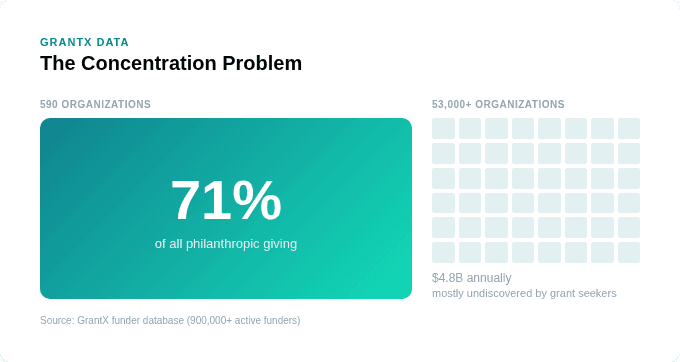
71% of all philanthropic giving comes from just 590 organizations.
The top 10% of funders — roughly 5,900 organizations — control 94% of all giving. That means every nonprofit in America is competing for the same short list. But there are 53,000+ funders outside that top 10%, deploying $4.8 billion annually, that most organizations never discover.
$772K is the average annual distribution per private foundation in our database.
The average private foundation holds $13.7 million in assets. With payout rates climbing and 87% of foundation leaders reporting increased demand for grants in 2026, even small shifts in distribution create real new dollars across tens of thousands of funders. Most of these foundations aren’t on the radar of the organizations competing for Gates and Ford.
Grant-Making Capacity by Funder Type
Funder Type | Total Capacity | Median Grant |
|---|---|---|
Private Foundation | $55.0B | $42,006 |
Public Charity | $49.8B | $45,000 |
Corporate (CSR + Foundation) | $32.3B | $50,000 |
Family Foundation | $15.5B | $50,000 |
University | $12.8B | $80,000 |
State | $11.3B | $80,150 |
Community Foundation | $8.9B | $103,212 |
Source: Grantx funder database. Total capacity reflects aggregate maximum grant sizes for funders with financial data on file. Median grant reflects the typical award size by funder type.
One more note on our data: 88% of funder records in our database were verified or updated within the last 30 days. Every record is less than six months old. In that window, we identified over 25,500 new non-federal funders — organizations that filed new IRS documents, opened new grant programs, or entered our tracking for the first time. The funding landscape changes fast, especially right now, and stale data leads to wasted applications.
What to Do Right Now
Audit your federal exposure. Know exactly which grants are at risk and what percentage of your revenue they represent. If federal sources account for more than 40% of your budget, you need a diversification plan this quarter, not next.
Build state and community relationships now. As federal dollars move to pass-through mechanisms, your state agency contacts become your most important funding relationships. Community foundations are actively increasing giving. Map which state offices and community funders operate in your area.
Expand your foundation pipeline — far beyond the usual suspects. 71% of all giving comes from 590 organizations, and everyone is competing for them. The real opportunity is in the tens of thousands of funders that most organizations never discover. Education funders alone represent $15.7 billion in capacity across 31,500+ organizations. Grantmaking foundations hold $38 billion.
Prepare for compliance changes. If you hold active federal grants, review the new drawdown and indirect cost requirements now. Build documentation processes before your next drawdown request, not after.
Add DAFs to your fundraising strategy. Donor-advised funds distributed $65 billion last year and most nonprofits still don't have a plan for reaching them. If you're only pursuing traditional foundation grants, you're leaving one of the fastest-growing funding channels on the table.
Watch the new money. AI philanthropy is an entirely new category that didn't exist 18 months ago. Over $1.5 billion in AI-focused grant funding has been announced in 2026 alone. If your work touches technology, health, workforce development, or education, these are sources worth adding to your pipeline now.
Sources
Federal data: CRS, Urban Institute, ACE
Foundation giving: Chronicle of Philanthropy, Foundation Source, NPTrust
Corporate giving: Double the Donation, Harvard Law
DAF data: DAF Research Collaborative, Chariot
Burnout & sector data: Johnson Center, CEP, Independent Sector, BDO
Legal challenges: JURIST, NY Attorney General
Proprietary data: GrantX funder database (IRS filings, 900,000+ funders)